When your business in the United States needs to understand the universal waste definition, it can feel like navigating a complex regulatory maze. For IT managers, facility coordinators, and business owners, this category often seems to float somewhere between regular trash and full-blown hazardous material.
Think of it this way: the EPA created a special, simpler set of rules for common but potentially harmful items generated by commercial enterprises. It’s like an express lane designed to get specific things handled properly without all the usual red tape of hazardous waste disposal. This approach makes it easier for businesses across the United States to do the right thing and recycle these items safely, a core focus of our services at Beyond Surplus.
Demystifying The Universal Waste Rule for Businesses

Let’s imagine your company has two different waste scenarios. In one corner, you have a drum of highly corrosive industrial solvent. In the other, you have a pallet of spent fluorescent bulbs from a recent office-wide lighting upgrade. While both technically contain toxic materials, the risk they pose and the way they should be handled are worlds apart.
The EPA saw this problem clearly. Forcing every business to manage thousands of old batteries or lightbulbs with the same complex regulations meant for dangerous industrial chemicals just wasn't practical for a commercial audience. It was so burdensome that it often led to these items being thrown away improperly just to avoid the headache.
The Purpose of a Simpler Standard for Commercial Waste
To fix this, the Universal Waste Rule was born. It provides a more manageable set of guidelines for these specific, widespread waste streams generated by businesses. The whole point is to encourage the safe collection and recycling of these materials by making compliance less of a chore for commercial and enterprise operations.
When the rules are easier to follow, more businesses will follow them. The official regulations, found in Title 40 of the Code of Federal Regulations Part 273, cover distinct categories of items that show up in almost every type of commercial operation, from data centers to medical facilities.
This simpler approach means less paperwork for your team, longer periods you can store the waste on-site, and easier shipping requirements compared to fully regulated hazardous waste. It’s a practical, business-focused solution for a very common challenge in IT asset disposal and facilities management.
Key Items Covered Under the Rule for Businesses
The federal program identifies several core types of waste that qualify for this special handling. For most businesses, the list includes items you probably have on-site right now:
- Batteries: This covers everything from the lithium-ion batteries in your corporate laptops and tablets to the sealed lead-acid batteries in your data center's UPS systems.
- Lamps: Think fluorescent tubes, compact fluorescent lamps (CFLs), and any other bulbs that contain mercury, commonly found in commercial buildings.
- Mercury-Containing Equipment: This can include old thermostats, certain types of industrial switches, and various medical or laboratory equipment that use elemental mercury.
- Aerosol Cans: Even partially full aerosol cans are included, as they can be hazardous due to their pressurization and chemical contents.
Knowing which of your commercial waste streams fit this description is the first step in building a disposal program that is both efficient and fully compliant. If you want to dive deeper, check out our complete guide to universal waste management.
Exploring the Key Categories of Universal Waste
So, what exactly is universal waste? Forget about obscure industrial chemicals—we're talking about everyday items you walk past in your office, warehouse, or data center. For IT and facilities managers, these are the components that can create massive compliance headaches and environmental liabilities if not handled correctly.
The most common universal waste isn't hidden away. It's powering the very equipment your business depends on. Knowing what these items are, where to find them, and why they need special attention is the foundation of a smart, safe asset disposition plan.
Batteries From Laptops to Data Centers
Just about every part of a modern business runs on batteries. This is a huge category that covers a lot of different chemistries, and each one needs to be managed in its own way.
- Lithium-Ion (Li-ion): This is the power source for your entire fleet of corporate laptops, tablets, and smartphones. They're incredibly efficient, but they also carry a serious fire risk if they get damaged, short-circuited, or stored improperly. This makes careful handling during an IT refresh non-negotiable for business owners and IT managers.
- Sealed Lead-Acid (SLA): Think of these as the heavy-duty workhorses in your facility. You'll find them inside your data center's Uninterruptible Power Supply (UPS) systems, emergency lights, and security alarm backups. They contain lead and corrosive acid, which makes them a clear environmental hazard if they aren't recycled the right way.
- Alkaline & Others: Your everyday AA, AAA, C, and D batteries in wireless keyboards, mice, and other office gadgets also fall into this group. They might seem less risky than lithium-ion, but they can still leak corrosive materials over time.
You can't just toss these batteries into a bin with other e-waste. Separating and managing them correctly is a core part of any responsible electronics recycling program. They have to be treated as their own distinct universal waste stream.
Lamps Illuminating Your Workspace
Most businesses are switching to LED lighting, but millions of older, mercury-filled lamps are still lighting up offices, warehouses, and commercial spaces across the country. Regulators are especially focused on this category because of the potent neurotoxin inside.
When a fluorescent bulb breaks, gets tossed in a landfill, or is incinerated, that mercury can contaminate the air, water, and soil. This creates a long-term environmental liability for your organization that can be incredibly difficult to clean up.
A single four-foot fluorescent tube can contain enough mercury to contaminate over 7,000 gallons of water. Now, multiply that by the hundreds or even thousands of lamps in a typical commercial building, and you can see how quickly the environmental risk scales up.
Items in this category include:
- Fluorescent tubes of all sizes
- Compact Fluorescent Lamps (CFLs)
- High-Intensity Discharge (HID) lamps
- Mercury vapor lamps
Mercury-Containing Equipment
Beyond just lamps, mercury shows up in a surprising number of older devices that might still be lurking in your facility's closets and back rooms. As you upgrade your building’s infrastructure, you’re bound to come across them.
These items require the same careful handling as mercury lamps to prevent toxic vapor from escaping.
Key examples include:
- Older Thermostats: Many of the old, non-digital thermostats have a small glass vial with liquid mercury inside that acts as a switch.
- Switches and Relays: Before modern regulations, certain types of industrial and electrical equipment used mercury switches.
- Medical and Lab Equipment: Devices like barometers, manometers, and other scientific instruments can contain a significant amount of pure mercury.
When you're decommissioning old equipment, such as laboratory or medical devices, or renovating a space, making sure you identify and separate these devices is a crucial step for staying compliant. For a more visual guide, you can see our list of common universal waste examples that your business might be generating.
Understanding Your Handler and Generator Obligations
Okay, so you've identified which items in your business count as universal waste. Now comes the important part: figuring out what you actually need to do about it. The EPA knows that not all businesses are the same, so they've created two different sets of rules based on one simple factor: how much of this waste you have on-site at any given time.
Getting this right is crucial. Your classification determines your specific legal responsibilities. It’s a bit like having different classes of driver's licenses—the rules you have to follow depend on the scale of your operation.
Small vs. Large Quantity Handlers
The EPA has two main categories for businesses handling universal waste. Knowing where you fit is the very first step to staying compliant.
- Small Quantity Handler of Universal Waste (SQHUW): Your business is in this group if you accumulate less than 5,000 kilograms (that's about 11,000 pounds) of total universal waste on-site at any single time.
- Large Quantity Handler of Universal Waste (LQHUW): If your business has 5,000 kg or more of universal waste stored up, you're considered an LQHUW and have a few more hoops to jump through.
For most companies, that 5,000 kg threshold is a pretty high bar to clear. Think about it—that’s the equivalent of 20 to 25 full pallets of old computers or thousands upon thousands of fluorescent bulbs. Because of this, the vast majority of businesses, from small offices to even larger companies, will almost always be classified as SQHUWs.
The Essential Compliance Playbook for All Handlers
No matter which category you fall into, there's a core set of rules everyone must follow. These aren't just suggestions; they are the federal mandates that form the foundation of the universal waste program. Getting these basics wrong is one of the fastest ways to run into compliance issues and potential fines.
The single most important rule to remember is the one-year accumulation limit. You cannot keep universal waste at your facility for more than one year from the day it was generated. This rule is in place to stop businesses from becoming long-term storage sites for potentially hazardous materials.
This flowchart gives you a simple visual for how to think about these items.
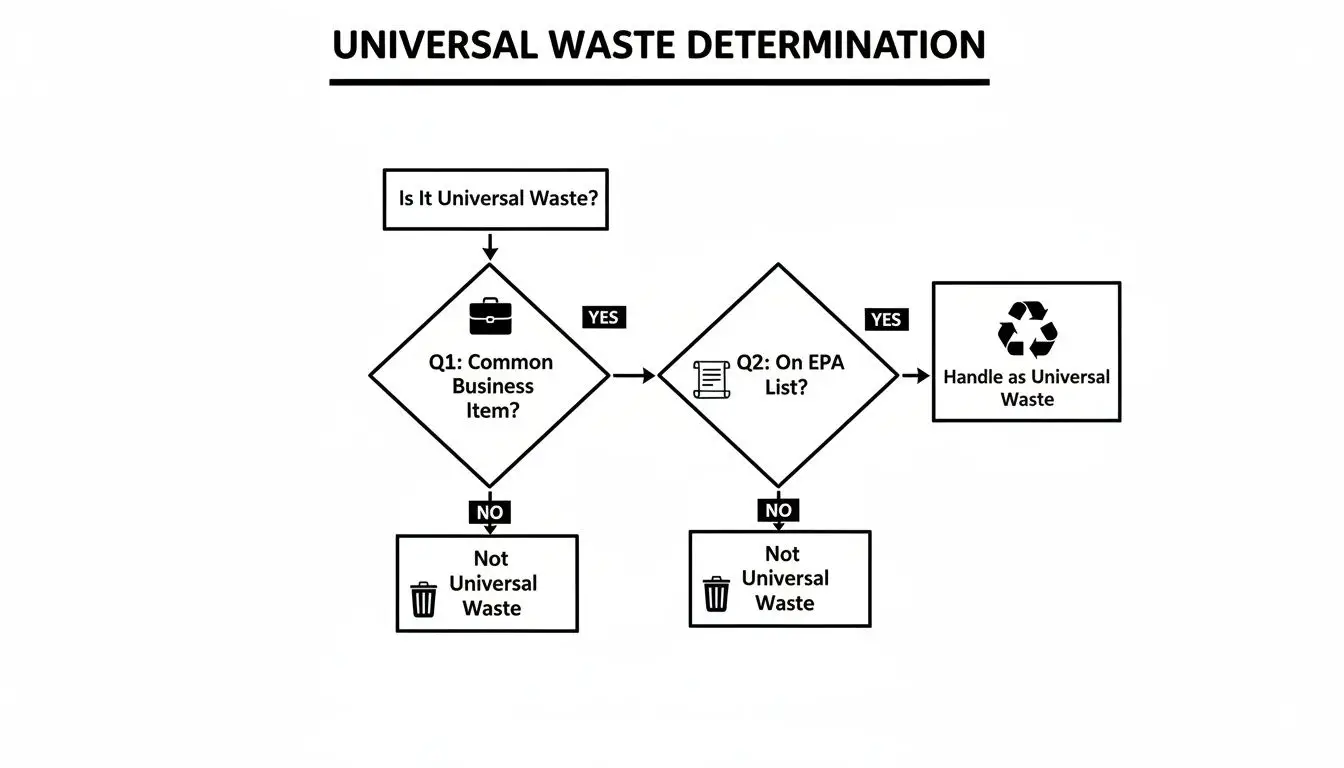
As the chart shows, if a common business item is on the EPA's list, you have to manage it under these specific rules—not just toss it in the dumpster.
To make sure you're meeting the one-year limit and other key requirements, you need a straightforward system in place. Here's what that looks like in practice:
- Labeling and Marking: Every item or container holding universal waste must be clearly labeled. A box of old laptop batteries, for instance, needs a label that says "Universal Waste—Batteries." This simple step is vital for informing employees, inspectors, and emergency personnel what's inside.
- Dating: You must be able to prove how long the waste has been on-site. The easiest way is to just write the date on the container or a tag when you first start adding waste to it.
- Proper Storage: Waste must be stored in a way that prevents leaks or spills. For example, keep batteries in a container that doesn't conduct electricity to avoid short circuits, and pack old fluorescent tubes in sturdy boxes to prevent them from breaking.
Key Takeaway: As a handler, your main jobs are to identify, label, date, and safely store universal waste. And above all, make sure it's sent for recycling or proper disposal within one year.
To help you keep track, this table breaks down the main obligations for both Small and Large Quantity Handlers.
Universal Waste Handler Obligations At-a-Glance
| Requirement | Small Quantity Handler (SQHUW) | Large Quantity Handler (LQHUW) |
|---|---|---|
| Accumulation Limit | Cannot accumulate more than 5,000 kg at any time. | Can accumulate 5,000 kg or more. |
| Storage Time Limit | Maximum of one year. | Maximum of one year. |
| Labeling/Marking | Required for all universal waste. | Required for all universal waste. |
| Employee Training | Must inform employees of proper handling and emergency procedures. | Must ensure all employees are thoroughly trained on procedures. |
| EPA ID Number | Not required. | Required; must notify EPA and get an ID number. |
| Recordkeeping | Not required (but highly recommended). | Required; must keep records of shipments for three years. |
While SQHUWs aren't federally required to keep records, it’s a smart business practice. Having a paper trail of what you sent, where it went, and when you sent it provides an extra layer of protection.
Extra Duties for Large Quantity Handlers
If your organization grows to the point where you cross that 5,000 kg line, you officially become an LQHUW, and a few more rules kick in. You still have to do everything an SQHUW does, but you'll also need to:
- Get an EPA Identification Number: This registers your facility with the EPA as a site managing a significant amount of universal waste, putting you on their radar.
- Keep Detailed Records: You are required to maintain records of every shipment of universal waste you send out or receive. These records must be kept for a minimum of three years.
These additional steps are all about accountability. For facilities handling such large volumes, the EPA wants a clear chain of custody to track where the waste is going.
Whether you're a small office or a large corporation, working with a certified ITAD partner like Beyond Surplus takes the guesswork out of this process. We ensure every one of these obligations is handled correctly, providing you with the documentation you need to prove compliance and protect your business.
Navigating the federal Universal Waste Rule is a solid start, but it’s just that—a start. The EPA’s regulations are the floor, not the ceiling. Every state has the power to adopt, tweak, or even build upon these federal rules.
This creates a complex patchwork of regulations across the country, which means a one-size-fits-all compliance strategy just won’t cut it. What keeps you compliant in one state could get you into trouble right across the border.
The Georgia Example: A Common Point of Confusion
Let’s look at a real-world example right here in Georgia. One of the most common questions we get from facility and IT managers is, “Are electronics considered universal waste?”
The answer isn’t a simple yes or no. Georgia has adopted the federal universal waste program, so items like batteries, lamps, and mercury-containing equipment fall under those streamlined rules. But here’s the key distinction: Georgia has not added "electronics" or "e-waste" as its own state-specific universal waste category.
This is where things get tricky for businesses handling IT asset disposition.
- Components as Universal Waste: The lithium-ion battery in that old corporate laptop? That's definitely universal waste. The same goes for the mercury backlight in an older flat-screen monitor.
- The Device Itself: The laptop’s plastic casing, the circuit board, and the monitor housing are not universal waste. Instead, they are classified as solid waste and need to be managed under separate e-waste guidelines to keep them out of landfills.
This difference is absolutely vital. You can't just label an entire pallet of old computers as "Universal Waste—Electronics." You have to manage the universal waste components inside those devices under one set of rules, and the rest of the machine under another.
Why Localized Knowledge Is Key to Avoiding Liability
This layered regulatory landscape is a major blind spot for many businesses. Getting state-specific rules wrong can easily lead to improper disposal, which opens you up to serious fines and long-term environmental liability. Simply shipping a mixed load of unsorted electronics under a universal waste manifest, for example, could be a costly compliance violation.
Your best defense is a certified partner who has deep expertise in both federal standards and the specific nuances of state regulations. They know that compliance in Georgia requires a different playbook than in other states. To get a better handle on the state's specific approach, you can learn more about managing business e-waste recycling in Georgia through our specialized services.
Ultimately, ignoring state-level details exposes your company to risk you don't need to take. An expert partner ensures your retired IT assets are handled correctly according to the rules in every jurisdiction you operate in, protecting your business from the financial and reputational fallout of a compliance mistake.
Connecting Universal Waste to Your IT Asset Disposition Strategy
Every retired laptop, server, and uninterruptible power supply (UPS) is more than just old equipment—it’s a container filled with universal waste. Bridging the gap between environmental rules and your IT Asset Disposition (ITAD) program isn't just good practice; it’s an essential part of managing risk for your business.
Failing to see this connection can lead to serious compliance headaches and financial penalties. The lithium-ion batteries, mercury-containing backlights, and lead-acid components inside your electronics are exactly what makes them a source of universal waste.
From IT Closet to Environmental Liability
When an office closes or a data center is decommissioned, the focus is usually on data security and asset recovery. But every device you retire poses its own environmental challenge. For instance, a single pallet of old laptops holds hundreds of individual lithium-ion batteries, and each one is a potential fire hazard if mishandled.
Likewise, a server room full of old UPS systems can contain hundreds of pounds of lead and corrosive acid. Treating these devices like simple scrap metal means you're ignoring the regulated materials inside, putting you on a fast track to non-compliance. This is one of the most common—and costly—mistakes we see in corporate electronics disposal.
Transforming Risk into a Compliant Process
This is where a certified ITAD partner turns a regulatory minefield into a smooth, documented process. Instead of your team having to sort through thousands of devices, an expert partner builds universal waste management right into the ITAD workflow.
This process breaks down into a few key steps:
- Identification: Trained technicians spot and identify all universal waste components as they process your retired assets.
- Segregation: Batteries, lamps, and other regulated items are carefully removed and sorted from the main e-waste stream into designated, properly labeled containers.
- Documentation: Every step is tracked, creating an unbroken chain of custody from your facility all the way to the final recycling destination.
By managing this process from start to finish, a certified partner effectively offloads the environmental liability from your organization. You receive a certificate of recycling that proves you met your obligations, protecting your business long after the assets have left your control.
Understanding this connection is fundamental to a secure and compliant ITAD program. For a deeper dive into how this fits into the larger picture, you can learn more about the principles of a proper IT Asset Disposition strategy.
The Importance of Certified Chain of Custody
The moment your IT assets leave your building, you’re trusting your vendor to handle them according to a web of federal, state, and local laws. If you use an uncertified hauler who improperly disposes of your equipment—and the universal waste inside—your company is left legally on the hook for any cleanup costs and regulatory fines.
A certified ITAD provider gives you a defensible, auditable trail that proves you did your due diligence. They make sure that batteries go to specialized recyclers, mercury is captured safely, and all materials are handled in an environmentally sound way. This isn't just about recycling; it's about protecting your company's reputation and bottom line.
Beyond state-specific rules, being aware of broader regulatory frameworks like the CE marking requirements for electronic equipment is also crucial when managing electronic universal waste. This commitment to process and documentation is what separates professional ITAD from a simple electronics hauling service, guaranteeing your project is compliant every step of the way.
Your Universal Waste Compliance Action Plan
Okay, we’ve covered a lot of ground. Now, let's translate all that information into a practical plan you can use at your facility. This is where the rubber meets the road—moving from knowing the rules to actually following them.

Think of the next few steps as your go-to guide for building a solid program. It's all about taking the guesswork out of the process and protecting your business from the headaches of improper waste handling.
A Practical Checklist for Staying Compliant
Turning regulations into daily habits is much easier when you have a structured approach. Follow these five core steps to get your universal waste management program up and running.
1. Know What You Have: Perform a Facility-Wide Audit
You can't manage what you don't measure. The first step is to do a full walkthrough of your entire facility. Don’t forget to check offices, storage closets, server rooms, and warehouses.
- Identify every potential universal waste stream. Look for things like spent batteries (lithium-ion, lead-acid, alkaline), old fluorescent lamps, outdated mercury thermostats, and used aerosol cans.
- Document the types and estimate quantities. Get a rough idea of how much you generate on a regular basis. This information is the foundation for everything that follows.
2. Set Up Your Collection Stations
Next, you'll need to designate specific, clearly marked areas for collecting universal waste. These spots need to be set up to prevent any accidental breakage or spills, which could create a much bigger problem.
- For batteries, use sturdy, non-conductive containers to keep them from short-circuiting.
- Keep fluorescent lamps in their original boxes or other protective packaging. This simple step can prevent breakage and a potential mercury release.
- Make sure every container is clearly labeled. It needs the words "Universal Waste" followed by what’s inside, like "Universal Waste—Batteries".
3. Figure Out Your Handler Status
Using the numbers from your audit, estimate the total weight of universal waste you might have on-site at any one time. This simple calculation will determine your official status and what’s required of you.
If you have less than 5,000 kg (about 11,000 lbs) on-site at any time, you’re a Small Quantity Handler (SQHUW). If you go over that limit, you become a Large Quantity Handler (LQHUW), which comes with extra rules like getting an EPA ID number. The good news is most businesses fall into the SQHUW category.
4. Start the Clock: Implement a Date Tracking System
That one-year accumulation clock is one of the most important compliance deadlines to watch. You need a simple, reliable way to prove how long waste has been stored.
- As soon as you put the first item into a collection container, mark that container with the date.
- It can be as easy as writing "Accumulation Start Date: [Date]" on the label with a permanent marker. This shows inspectors you’re on top of your storage timeline.
5. Partner With a Certified Recycler
Your responsibility doesn't just end when the waste leaves your property. You have to make sure it’s transported and recycled by a qualified, trustworthy partner. Financial preparedness is also key; consider how a Pollution Insurance policy can shield your business from the costs of unforeseen environmental issues.
A certified ITAD and recycling company will give you a complete chain of custody and a certificate of recycling. This documentation is what officially transfers liability away from your organization. It's critical to vet your vendors thoroughly. You can learn more about what to look for with our vendor due diligence checklist for ITAD services.
Frequently Asked Questions About Universal Waste
When it comes to universal waste, we get a lot of questions about the day-to-day details. Let's clear up some of the most common ones we hear from businesses, so you can handle these materials correctly and with confidence.
What Happens if I Exceed the One-Year Storage Limit?
Going over the one-year storage limit is a big deal in the eyes of regulators. If an inspector finds out, you're looking at potential fines.
But the bigger problem is that all the waste you've stored past that one-year mark instantly loses its universal waste classification. It gets re-categorized as fully regulated hazardous waste, which means you’re suddenly facing much stricter, more complicated, and more expensive disposal rules.
Can My Business Transport Its Own Universal Waste?
Technically, yes, but it comes with some serious strings attached. A Small Quantity Handler of Universal Waste (SQHUW) can transport its own universal waste to another handler or a final destination facility.
However, you're still on the hook for complying with all Department of Transportation (DOT) regulations for shipping hazardous materials, and that can get complicated fast. For most companies, the risk and paperwork just aren't worth it. Using a certified recycling partner who manages all the transport and documentation is almost always the smarter, safer path.
How Do I Choose a Certified Recycling Partner?
Picking the right partner is probably the most important decision you'll make to protect your business. You absolutely want to look for a vendor holding certifications like R2 (Responsible Recycling) or e-Stewards. These aren't just fancy logos; they prove the recycler follows strict protocols for environmental safety and data security.
A reputable partner will provide a complete chain of custody and a certificate of recycling for every shipment. This documentation is your legal proof that you fulfilled your compliance obligations and that liability was properly transferred.
Don’t be shy about asking for proof of their certifications, references, and information on their downstream recycling process. A transparent, well-documented operation is the sign of an ITAD partner you can trust.
Managing universal waste correctly is a critical part of your overall risk management strategy. For a partner that guarantees compliance and provides a complete, documented solution for your IT assets, contact Beyond Surplus. Discover our certified electronics recycling and secure IT asset disposal services.