For any Georgia-based business with offices across the country, managing retired IT assets is a significant logistical and security challenge. This is not a simple disposal task; it requires a strategic approach to protect sensitive data and ensure compliance. Partnering with a single, certified provider for nationwide electronics recycling in Georgia transforms this complex operational hurdle into a streamlined, secure, and fully auditable process, ensuring every piece of electronic waste is handled to the highest standards, regardless of its location.
Why Georgia Businesses Need a Nationwide Commercial Recycling Partner
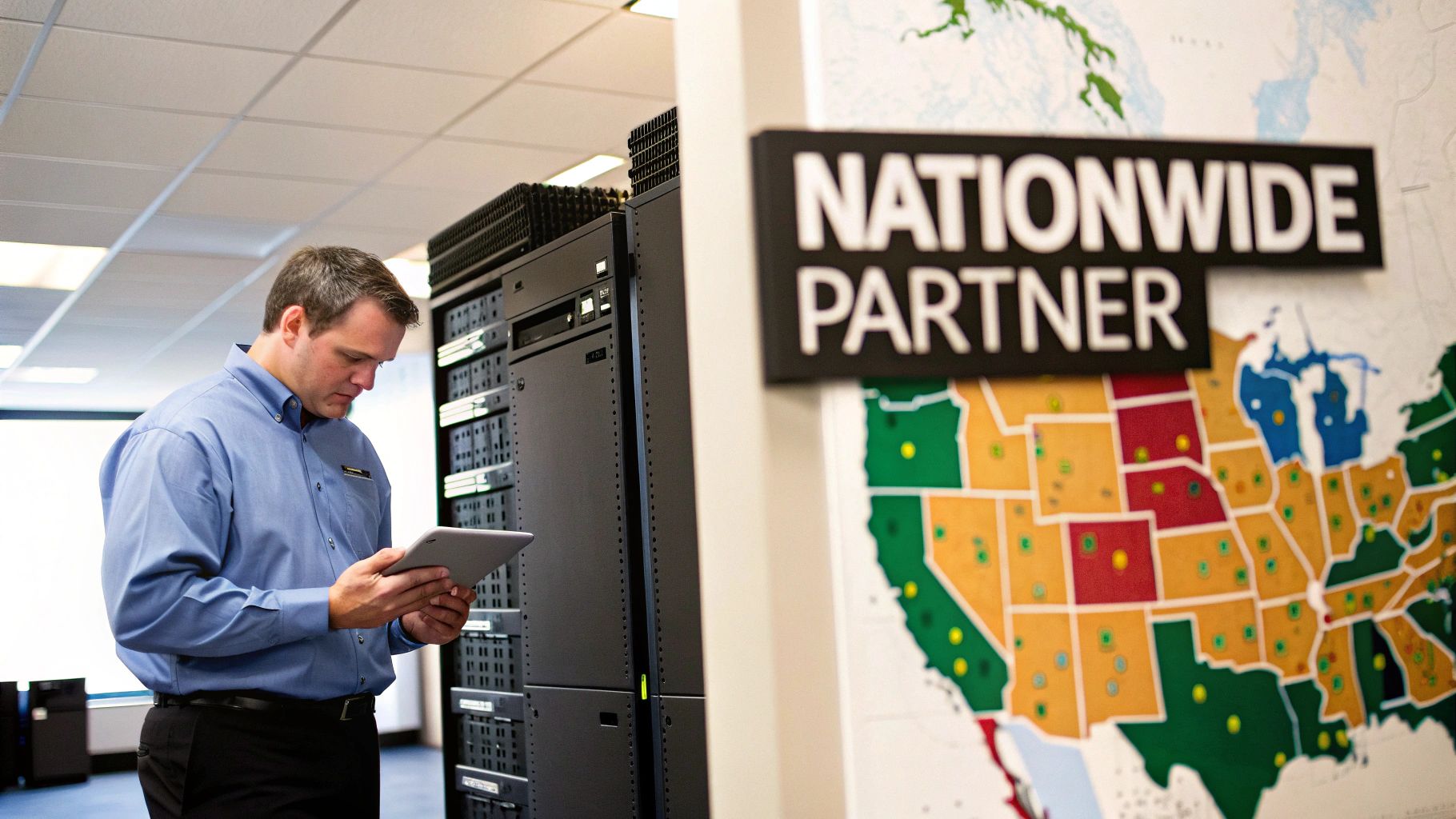
Coordinating electronics recycling for a multi-state operation is fundamentally different from a single-office cleanout. When your enterprise has facilities in Atlanta and Savannah, plus others in different states, you face a patchwork of local vendors, inconsistent service levels, and a fragmented chain of custody. This decentralized approach creates unnecessary risk and operational inefficiency.
A centralized, nationwide partner based out of Georgia eliminates these problems. Instead of juggling multiple contacts and tracking disparate pickups, your team gains a single point of contact and unified accountability. This consistency is critical for maintaining robust data security and ensuring regulatory compliance across your entire organization.
The Strategic Advantages of a Single ITAD Partner
Imagine your enterprise is decommissioning facilities in Alpharetta, Georgia, and Austin, Texas, simultaneously. Without a unified partner, your IT and facilities teams must source, vet, and manage two separate local recyclers. This doubles the administrative burden and exponentially increases the risk of a breakdown in your chain of custody.
With a nationwide provider, one directive from your Georgia headquarters manages the entire project. The benefits are clear and immediate:
- Standardized Security Protocols: Every location receives the same high standard of data destruction and secure logistics. There are no weak links in your security framework.
- Simplified Compliance: You receive one consolidated set of documentation—such as a master Certificate of Recycling and Data Destruction—covering all assets from all locations. This streamlines audits and demonstrates uniform compliance with regulations like the FTC Disposal Rule.
- Operational Efficiency: Your team reclaims valuable time previously spent researching, negotiating with, and managing multiple regional vendors. All logistics are managed through a single, trusted partner.
The real value of a nationwide service is turning a logistical nightmare into a predictable, secure, and manageable process. It ensures your company's high standards for data security and environmental responsibility are upheld everywhere you operate, not just at home in Georgia.
Beyond Logistics to Financial Recovery
This unified approach also directly impacts your bottom line. A partner with a national reach possesses a broader network for remarketing reusable IT assets. This means valuable equipment from any of your sites—whether it's servers from a Suwanee data center or laptops from a California sales office—can be evaluated for its highest possible resale value.
By consolidating the process, you gain a clearer, comprehensive view of your asset recovery potential. This aids in IT budget planning and maximizes the return on your original technology investments, turning a cost center into a potential revenue stream. Contact Beyond Surplus to learn more about our IT equipment buy back services.
Choosing Your Certified ITAD Partner in Georgia
Selecting the right IT Asset Disposition (ITAD) partner for your business in Georgia is a critical risk management decision, not a simple procurement task. The vendor you choose becomes the temporary guardian of your company's most sensitive data and its environmental reputation. Therefore, your evaluation must extend far beyond a simple price quote when vetting a provider for nationwide electronics recycling.
Your assessment must begin with their industry certifications. These are the non-negotiable standards that distinguish professional, secure operators from unqualified scrap haulers. Any legitimate partner will proudly display their credentials, which serve as third-party validation of their entire operational process.
Verifying Essential Certifications
When evaluating a potential partner, you must request proof of current and active certifications. These standards are the foundation of any secure and responsible electronics recycling operation.
- R2v3 (Responsible Recycling): This is the leading global standard for electronics repair and recycling. R2v3 certification signifies the vendor adheres to strict guidelines for environmental safety, worker health, and data security throughout the disposal chain. You can explore the details in our guide to what is R2 certification.
- e-Stewards: This is another highly respected certification with a primary focus on preventing the illegal export of hazardous e-waste. It demands stringent accountability for every component, ensuring responsible downstream management.
- NAID AAA Certification: This certification is exclusively focused on data destruction. A vendor with NAID AAA certification has undergone intensive, unannounced audits of their hiring practices, operational security, and destruction methodologies. It provides the highest level of confidence that your data will be completely and permanently destroyed.
A vendor holding these certifications has invested significant resources into building secure, compliant, and auditable systems. It is the clearest initial indicator that they can meet the stringent demands of a corporate client.
Scrutinizing the Chain of Custody
Certifications are only the starting point. You must also rigorously assess a potential partner's ability to provide a transparent and unbroken chain of custody. This is the documented trail that follows every single asset from the moment it leaves your Georgia facility to its final disposition, whether recycling, resale, or destruction.
Do not hesitate to request sample documentation. A professional provider should readily provide detailed reports that include:
- Serialized asset tracking for high-value items.
- Secure, GPS-tracked logistics and transport protocols.
- Access-controlled, monitored processing facilities.
- A clear downstream vendor management program.
This level of detail is essential for your own compliance and internal audits. It is the proof you need to demonstrate due diligence and the proper transfer of liability.
A strong ITAD partner doesn't just promise security; they prove it with an auditable paper trail for every single device they handle. This documentation is your ultimate defense against a potential data breach or compliance failure.
The growth of Atlanta as a hub for professional recycling services reflects this demand for secure, compliant solutions. As the U.S. e-waste recycling market is projected to see a 4.8% CAGR through 2025, businesses in regulated industries like finance and healthcare are prioritizing certified partners to mitigate the risks of data breaches and illegal exports.
Assessing Their Technical Capabilities
Finally, you must ensure the partner can handle the specific types of assets your business generates. A general e-waste recycler may not be equipped for the specialized requirements of decommissioning a data center, disposing of medical equipment, or recycling sensitive laboratory instruments.
Inquire about their experience in your industry and request case studies or references. A proven track record of managing complex, sensitive, or high-volume equipment is a key differentiator when selecting a long-term partner for your nationwide electronics recycling needs in Georgia.
Deciding Between On-Site and Off-Site Data Destruction
When retiring your company’s IT assets, the single most critical step is ensuring all sensitive data is permanently and irreversibly destroyed. For any business in Georgia, especially those managing nationwide electronics recycling, this is a legal and ethical imperative.
The primary decision you will face is whether to have the data destroyed at your location (on-site) or at a secure, certified facility (off-site). Each approach offers distinct advantages, and the optimal choice depends on your company's security policies, logistical requirements, and budget.
Choosing the right partner and process is a major deal. This visual guide breaks down the key checkpoints for picking a trusted ITAD provider.
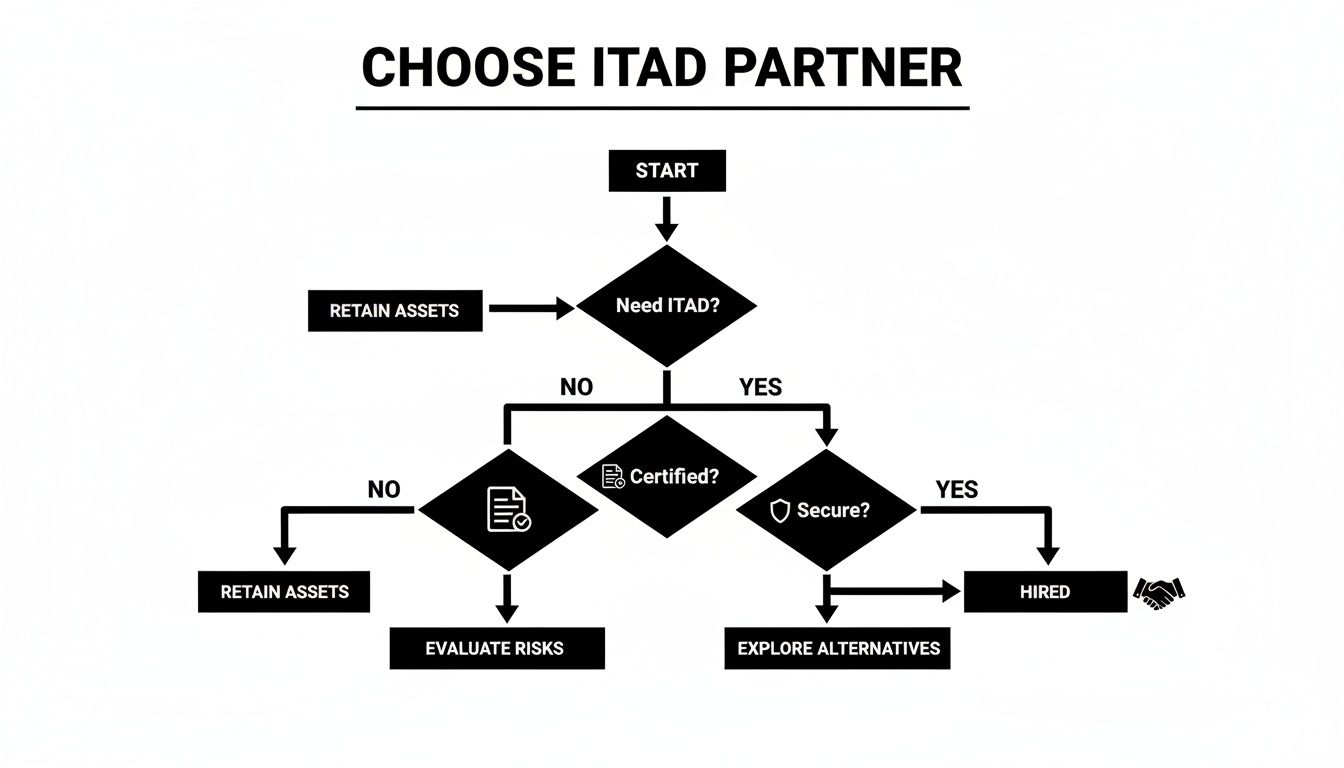
As the flowchart shows, once you know you need ITAD services, the next critical step is to verify a potential partner's certifications and security protocols before you sign on the dotted line.
The Case for On-Site Physical Destruction
On-site data destruction is widely regarded as the gold standard, particularly for organizations with the most stringent security requirements. A specialized shredding truck arrives at your office in Atlanta or Savannah, and your team can physically witness the entire process.
You can observe the scanning of serial numbers on your hard drives and then watch as those drives are fed into an industrial-grade shredder, reducing them to fragments in minutes. This method provides absolute peace of mind because the chain of custody for your live data ends at your facility.
- Maximum Security: There is zero risk of data compromise during transit. Your sensitive information never leaves your property intact.
- Direct Verification: Your compliance or IT team can witness the destruction firsthand, providing undeniable proof for internal audits and stakeholders.
- Immediate Confirmation: You receive a Certificate of Data Destruction on the spot, confirming which assets were destroyed and when.
This is the preferred method for government agencies, financial institutions, and healthcare providers who cannot accept any risk of a data breach. The primary trade-off is typically cost, as mobilizing specialized equipment and personnel to your location comes at a premium.
On-site shredding brings the secure processing plant directly to you. It's the ultimate solution for companies where absolute, visual verification of data destruction is non-negotiable.
The Efficiency of Off-Site Data Destruction
For many businesses, off-site destruction provides the optimal balance of high security, cost-effectiveness, and efficiency. The process begins with a secure, documented pickup from your Georgia office by vetted logistics professionals. Your assets are transported in locked, GPS-tracked vehicles to a facility under 24/7 surveillance with strict, audited access controls.
Upon arrival, every drive is inventoried before being destroyed in a high-capacity shredder. This approach is exceptionally efficient, especially for large-scale projects or when consolidating assets from multiple locations nationwide for processing.
While you do not witness it in person, a NAID AAA certified partner provides a complete audit trail, including serialized reporting, and can offer video verification upon request. The security at these facilities is rigorously maintained and confirmed through regular, unannounced audits to ensure they meet the highest industry standards.
Data Wiping: A Value-Conscious Alternative
Not all data destruction must result in physical destruction. For newer, more valuable IT assets—such as recent-generation servers, laptops, and networking equipment—certified data wiping is a smart alternative that preserves the hardware’s value for resale.
This process utilizes specialized software to overwrite every sector of a storage device multiple times, rendering the original data completely unrecoverable.
The key is ensuring the wiping method meets rigorous standards, such as NIST 800-88 Purge. This level of sanitization is recognized by the Department of Defense and is sufficient for most corporate and government data.
By choosing certified wiping, your business can turn retired assets into a revenue stream through an IT buyback program. That capital can directly offset recycling costs and even contribute to new equipment purchases. To understand this better, you can learn more about the specifics of secure hard drive destruction and how it fits into a broader ITAD strategy.
On-Site vs Off-Site Data Destruction Methods
To help you decide, let's break down the three primary methods side-by-side. Each offers a different balance of security, convenience, and value recovery potential, making one a better fit for certain situations.
| Method | Security Level | Best For | Value Recovery Potential | Documentation Provided |
|---|---|---|---|---|
| On-Site Shredding | Highest | Maximum-security needs (finance, healthcare, government); absolute verification required. | None (assets are physically destroyed) | Certificate of Data Destruction (on-site) |
| Off-Site Shredding | Very High | Large volume projects, multi-location pickups; balancing high security with cost. | None (assets are physically destroyed) | Full audit trail, serialized report, video verification (on request) |
| Certified Wiping | High | Newer, valuable assets (laptops, servers) eligible for resale or redeployment. | Highest (enables IT asset buyback programs) | Certificate of Data Sanitization (per NIST 800-88 standards) |
Ultimately, the best choice depends on your organization's risk tolerance. If witnessing the destruction is a must-have for compliance, on-site is the clear winner. However, if you have assets with resale value or need an efficient, highly secure process for a large number of devices, off-site wiping or shredding at a certified facility is often the most practical and economical solution.
Managing Nationwide Logistics from Your Georgia HQ

For any company with a footprint beyond Georgia, coordinating e-waste logistics can quickly spiral into a logistical challenge. Managing retired assets from offices in different states often involves juggling multiple local vendors, each with their own pricing, processes, and documentation. This patchwork approach is not only inefficient—it introduces significant security gaps into your asset disposition chain.
The solution is to centralize control with a single, expert partner. By managing all your nationwide electronics recycling Georgia projects from your headquarters, you establish a consistent, secure, and fully auditable system. What was once a logistical nightmare becomes a streamlined operation, ensuring your company's high standards are upheld everywhere.
The Single Point of Contact Advantage
Consider this common scenario: your Georgia-based corporation is decommissioning offices in California and New York simultaneously. Without a national partner, your IT team must find and vet two separate local recyclers. This means double the work, double the contracts, and double the risk of inconsistent data security protocols.
A single point of contact fundamentally changes the process. One call from your Atlanta office initiates a coordinated effort. Your nationwide provider handles all scheduling, dispatches secure logistics teams to each location, and ensures every asset is processed under a single, pre-approved standard. It simplifies communication and provides total accountability.
From Inventory to Synchronized Pickup
Managing a multi-state project should be methodical and secure, all driven from your Georgia command post.
- Consolidated Inventory: First, you provide an inventory list for all locations. A proficient ITAD partner will help you refine this list, identifying assets with potential resale value versus those designated for recycling.
- Strategic Scheduling: Pickups are scheduled to align with your project timeline. Whether you require simultaneous pickups or a staggered approach, the logistics are synchronized to minimize business disruption.
- Secure On-Site Execution: Vetted, professional logistics teams arrive at each site prepared to execute. They manage all heavy lifting—packing, palletizing, and loading your equipment onto secure, GPS-tracked vehicles.
This structured process ensures your assets are protected from the moment they leave your control. For companies requiring comprehensive support, it's beneficial to explore nationwide reverse logistics services that manage the entire lifecycle of retired IT equipment.
The Critical Role of a Vetted Fleet and Serialized Tracking
The security of your assets in transit is paramount. A provider utilizing its own dedicated fleet or a network of highly vetted transport partners maintains far greater control over the chain of custody. This mitigates the risks associated with using third-party freight carriers not trained in handling sensitive electronics.
Furthermore, serialized asset tracking is non-negotiable. Every key asset is scanned and logged before leaving your facility, and its journey is monitored through final processing. This granular detail is crucial for accurate reporting and creating an unbreakable audit trail.
When you can track every server and laptop from every office on a single report, you have achieved true logistical control. This level of transparency is impossible to replicate when using a patchwork of local, unvetted recyclers.
One Project, One Set of Documents
Perhaps the most significant benefit of a centralized approach is the streamlined documentation. Instead of chasing and reconciling reports from multiple vendors, you receive one consolidated, easy-to-understand package.
This master report typically includes:
- A master Certificate of Recycling covering all assets from every location.
- A comprehensive Certificate of Data Destruction with serialized details.
- A detailed reconciliation report providing a full accounting of the entire project.
This unified paperwork simplifies compliance audits. It provides clear, irrefutable proof that your organization has met its legal and ethical obligations for every retired asset, regardless of its origin. It is the final element that confirms your nationwide electronics recycling program is secure, compliant, and under your complete control.
Turning Old Tech into Revenue with IT Buyback Programs
Do not view your company's retired IT assets as merely a disposal problem; see them as a hidden source of revenue. For businesses in Georgia, an IT buyback program can transform old electronics from a liability into working capital. It is a strategic approach to nationwide electronics recycling Georgia that focuses on recovering the maximum value from your used equipment, which directly enhances the ROI on your original technology investments.
Not every retired device is destined for the shredder. A significant amount of equipment, especially gear that is only a few years old, still holds considerable value on the secondary market. A professional ITAD partner is essential for identifying and capitalizing on these opportunities.
Identifying High-Value Assets
The key to a successful buyback program is knowing precisely which assets are most valuable. While almost all equipment has some intrinsic material worth, certain categories consistently yield the highest returns.
Here are the key assets to flag for potential buyback:
- Recent-Generation Laptops and Desktops: Devices that are three to five years old remain in high demand, particularly enterprise models from brands like Dell, HP, and Lenovo.
- Enterprise Servers and Networking Gear: Critical components such as CPUs, RAM, and storage arrays from data centers often retain a significant portion of their value.
- Specialized Equipment: Do not overlook unique technology. Medical imaging devices, laboratory testing instruments, and other specialized commercial equipment can also be remarketed for a substantial return.
The condition of the equipment is also a major factor. Functional and cosmetically clean devices will always command a much higher price than those that are damaged or incomplete.
The Asset Valuation and Remarketing Process
Once valuable assets have been identified, they undergo a rigorous process to prepare them for resale and maximize your financial return.
It begins with meticulous testing to assess each asset's functionality and condition. Next, all data is securely and permanently erased using methods compliant with NIST 800-88 standards, with a certificate provided as proof. Finally, the equipment is cleaned, refurbished if necessary, and sold through established global remarketing channels.
A professional ITAD partner doesn’t just recycle your old tech. They act as your agent in the secondary electronics market, working to get you the best possible price for your retired assets. This turns what could be a simple disposal task into a genuinely smart financial decision.
Consider this: a university in Georgia completing a campus-wide laptop refresh could recover a significant portion of its initial investment. By working with a certified vendor, they could have thousands of three-year-old laptops securely data-wiped and resold. The revenue generated could directly offset the cost of new equipment, extending their IT budget. To see how this works, you can explore the details of IT equipment buy back services.
Real-World Success in Georgia
The U.S. electronics recycling industry is expanding, with Georgia at the forefront. This growth is driven by the immense volume of e-waste—a massive 6.9 million tons in 2023 alone. Smart companies in Georgia are converting this potential liability into a tangible asset.
For example, a financial institution in Macon recently recovered 40-50% of the original purchase price from hundreds of retired three-year-old laptops through certified data wiping and remarketing. In another case, a tech firm in Alpharetta decommissioned a rack of four-year-old servers and sold the components—CPUs, RAM, and SSDs—for thousands of dollars in returns.
This approach is about more than just financial recovery. It is a fundamental part of building a sustainable, circular IT economy. By extending the life of usable electronics, you not only benefit your company's bottom line but also contribute to reducing the environmental impact of e-waste. This makes IT buyback programs a clear win for both your finances and your corporate social responsibility goals.
Securing Your Compliance with Final Documentation
The process is not complete when the truck departs. The final, and most critical, phase of any IT asset disposition project is receiving the official documentation that formally transfers liability from your organization to your recycling partner.
These documents are more than receipts; they are your legal and compliance defense, proving you exercised due diligence for every retired asset. For any business engaged in nationwide electronics recycling Georgia, this paper trail is non-negotiable. It is your definitive proof of responsible disposal and secure data handling, closing the loop on your chain of custody.
The Two Pillars of ITAD Documentation
Two key documents form the foundation of your compliance record. Each serves a distinct but equally vital purpose in verifying your e-waste was managed correctly.
- Certificate of Recycling: This confirms your assets were processed in an environmentally sound manner, adhering to all local, state, and federal regulations. It should itemize the equipment received and attest that hazardous materials were handled properly.
- Certificate of Data Destruction: This is your primary risk management document. It certifies that every data-bearing device was sanitized or physically destroyed according to specific standards, such as NIST 800-88.
A legitimate certificate will include serial numbers for each hard drive or device, the destruction method used (e.g., shredding, wiping), the date of destruction, and the signature of an authorized official. You can learn more about what a comprehensive Certificate of Destruction should include to ensure it withstands an audit.
Think of these certificates as your "get out of jail free" cards. If an audit ever comes up or a data breach is traced back to improperly disposed equipment, this serialized documentation is your irrefutable proof that you followed proper procedure.
Connecting Your Paperwork to Compliance Mandates
These documents are not just for internal records; they are your direct line of defense for satisfying major regulatory frameworks.
For example, the FTC Disposal Rule requires businesses to take "reasonable measures" to protect consumer information. A Certificate of Data Destruction is that reasonable measure, documented and proven.
For healthcare organizations in Georgia, these certificates are vital for demonstrating HIPAA compliance. They prove that Protected Health Information (PHI) on old computers, servers, or medical devices was properly and permanently destroyed.
Securing this documentation is also part of a larger global responsibility. In 2022, the world generated a staggering 62 million tonnes of e-waste, yet recycling rates have struggled to keep pace.
By partnering with certified ITAD firms in Georgia, businesses ensure their equipment is processed ethically and receive the documentation that transfers liability. It is the final step that solidifies your commitment to both data security and environmental stewardship. You can get more insights on Georgia's role in the e-waste crisis from UNDP Eurasia.
When businesses in Georgia seek a nationwide partner for electronics recycling, several key questions consistently arise. IT managers and business leaders require clear, direct answers to make an informed decision that aligns with their security requirements and operational needs.
What Kinds of Business Electronics Can We Recycle?
A true nationwide service must cover the full spectrum of commercial IT assets, not just standard office equipment. This includes everything from desktops, laptops, and servers to more complex hardware like networking equipment, telecommunications systems, and large-scale data storage arrays.
Furthermore, a full-service partner like Beyond Surplus has the expertise to manage highly specialized equipment from various industries. We regularly handle assets from:
- Healthcare facilities (medical diagnostic tools, patient monitors)
- Manufacturing plants (industrial controls, robotics, automation hardware)
- Scientific labs (sensitive testing and measurement instruments)
If it is a piece of commercial electronic equipment, we have the certified processes and logistical capability to manage it securely, whether it is located in Georgia or anywhere in the lower 48 states.
How Is the Cost for a Nationwide Pickup Determined?
There is no one-size-fits-all price for nationwide electronics recycling. The cost is determined by the specific mix of equipment, total volume, pickup logistics, and the required level of data destruction.
For projects with a significant volume of valuable, newer equipment suitable for reuse, the service can often be free. In many cases, it can even generate a payment back to your company through an IT asset buyback program.
Conversely, a project involving older, zero-value equipment or a labor-intensive service like a complete data center cleanout may incur a service fee. A reputable partner will provide a transparent, itemized quote upfront, ensuring there are no surprises.
Do We Have to Box Everything Up Before You Arrive?
Absolutely not. A genuine "white-glove" ITAD partner manages all logistics, so your team does not have to.
Our professional, vetted team arrives at your facility—whether in Georgia or any other state—prepared to safely pack, palletize, and load all designated equipment.
This approach removes the burden and liability from your staff, guarantees secure transport, and eliminates the risk of damage. You simply identify the assets for removal, and our logistics crew handles the rest.
Ready to streamline your nationwide IT asset disposal? Beyond Surplus provides certified electronics recycling and secure data destruction for businesses across the country, all managed from a single point of contact. Contact Beyond Surplus for certified electronics recycling and secure IT asset disposal. Find out more at https://dentaldoctordelhi.com.